

🧠 Strategy Guide — March 2026

Pinball Rush Strategies — Tips to Win More in 2026

— HowTo schema with tips added, difficulty strategy refined

Six evidence-based strategies for Pinball Rush players: difficulty selection, Autobet configuration, session bankroll management, Bonus Saucer awareness, demo-first discipline, and volatility matching. Plus the strategies that never work and why.

96% RTP
6 Strategies
50 Max Bounces
3 Difficulty Levels
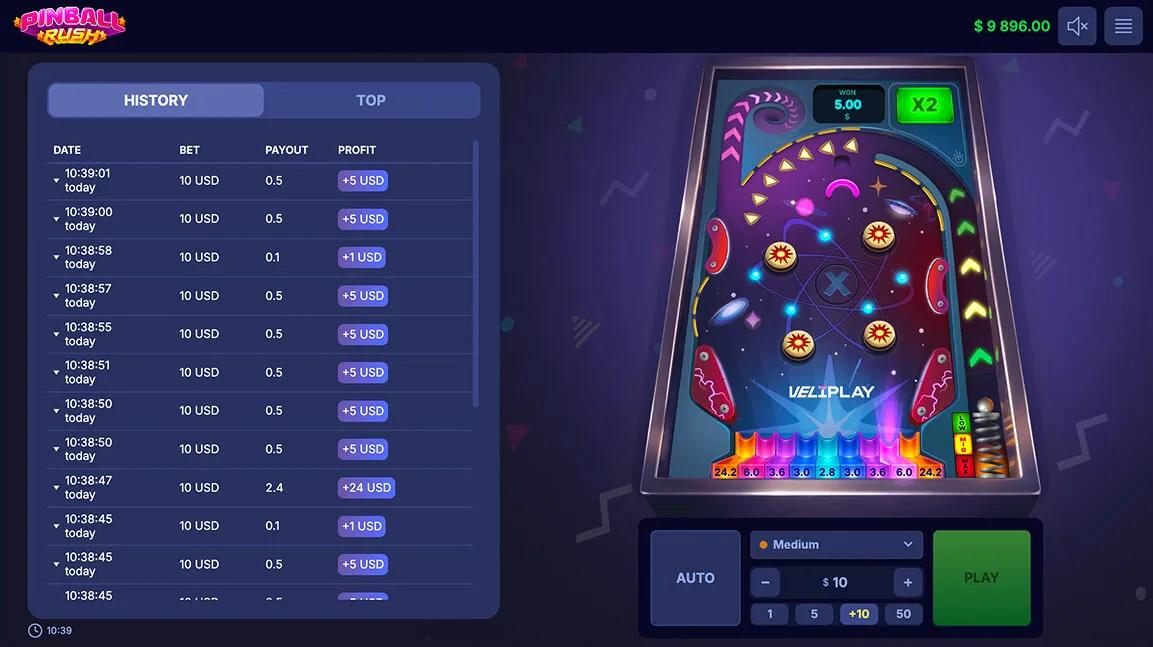
Pinball Rush game interface — strategies guide hero image
Disclosure: This site contains affiliate links. When you register at a partner casino we may earn a commission at no extra cost to you. Our reviews remain independent. About our methodology.

Understanding the Math First

Key insight: Pinball Rush has no guaranteed winning strategy — it is a provably fair RNG game. The effective strategies are about managing volatility through difficulty selection, enforcing session discipline with Autobet, and understanding that the Bonus Saucer is the highest-value outcome worth tracking.

Every Pinball Rush strategy rests on a single inescapable foundation: the game carries a 96% RTP and a 4% house edge. Before discussing what works, it is essential to understand exactly what this means for your sessions — because misunderstanding this number is the root cause of most strategic mistakes.

What 96% RTP Actually Means

RTP stands for Return to Player. A 96% RTP means that, over a statistically large sample of rounds (think tens of thousands), the game returns $96 for every $100 wagered. The remaining $4 is retained by the house. This is a long-run mathematical expectation — not a guarantee for any individual session.

In a single session of 30 rounds, the actual return can be anywhere from 0% (total loss) to many multiples of your starting bankroll (large win). Variance is high, especially on Hard difficulty. The 4% edge only becomes a reliable predictor over very large sample sizes. A 30-round session is nowhere near statistically significant.

What This Means for Strategy

Because the house edge is fixed and applies to every round independently, no betting pattern or session management technique can change your expected total return. What strategies can change is:

  • The volatility of your sessions — how wide the range of outcomes is across sessions.
  • Session length — how many rounds your bankroll survives at a given stake.
  • Risk of ruin — the probability that a session ends at zero before your planned stop point.
  • Consistency of experience — fewer emotional decisions, more disciplined execution.

Good Pinball Rush strategy is therefore bankroll and session management strategy. It does not beat the house. It shapes how you interact with the variance that the house edge produces. Holding that distinction clearly is the starting point for every strategy that follows.

Key number: With 96% RTP, your theoretical expected loss per $100 wagered is $4.00. On a $1 stake across 50 rounds, total wagered is $50 — theoretical expected loss is $2. This is a modest cost for entertainment, provided session limits are respected.

Strategy 1: Difficulty Selection

The highest-leverage decision you make before each round.

Difficulty selection is the single most impactful pre-round decision in Pinball Rush. It does not change the house edge, but it dramatically changes the shape of your session outcomes. Choosing the right difficulty for your session goal is the foundation of any coherent strategy.

When to Play Easy

Easy is the optimal choice when your session goal is extended play time with moderate swings. The outcome distribution on Easy is relatively flat — the probability of very high-value cell landings and very low-value cell landings is lower than on Hard. This produces more consistent round-to-round results, which means your bankroll erodes slowly and predictably.

Play Easy when: you are learning the game, your session bankroll is modest, your primary goal is entertainment rather than a specific multiplier target, or you want to observe bonus mechanics (Bonus Saucer, Multiplier Crater) without high-variance pressure.

When to Play Hard

Hard is appropriate only for short sessions with a specific high-multiplier goal. On Hard, the distribution has heavier tails — the highest-value cells and lowest-value cells are both more likely. This creates the potential for larger wins, but also the near-certainty of more frequent deep losses within a session.

Play Hard only when: you have a session bankroll of at least 100x your planned stake (vs. 50x for Easy), your explicit goal is a large multiplier outcome, and you are comfortable with the possibility of losing the full session bankroll before hitting that outcome.

Session Goal Recommended Difficulty Minimum Bankroll (units) Expected Session Character
Extended play, learning Easy 50x stake Slow variance, moderate swings
Balanced entertainment Medium 75x stake Mixed variance, occasional large swings
High-multiplier hunt Hard 100x stake High variance, large wins and losses
Bonus Saucer focus Easy or Medium 75x stake Moderate variance with bonus upside
Pinball Rush difficulty selection screen showing Easy, Medium and Hard options

Difficulty is selected before each round. You can change it freely between rounds — aligning difficulty to your session state is itself a valid strategy.

Strategy 2: Autobet + Smart Cashout Configuration

Automate discipline before emotions take over.

Pinball Rush rounds complete in roughly 30–90 seconds. At that pace, a manual-play session of 30 rounds takes under an hour — fast enough for decision fatigue and emotional betting to become real risks. Autobet and Smart Cashout exist to systematise your session rules before you start playing, removing the in-session temptation to deviate.

Configuring Autobet Effectively

The core Autobet decision is stake size as a percentage of your session bankroll. The standard recommendation is 1–2% per round, which gives you 50–100 rounds before total session loss — enough to experience the statistical distribution of outcomes across one sitting.

Set max rounds before starting. If you plan a 30-round session, enter 30 in the max rounds field and let Autobet stop automatically. This removes the "just one more round" psychological trap that extends sessions beyond planned limits.

Smart Cashout: The 1.5x–2.5x Range

Smart Cashout triggers an automatic payout when the running multiplier reaches your target threshold. The recommended range for most players is 1.5x to 2.5x. Here is the reasoning:

  • Below 1.5x: You cash out too early on most rounds, limiting upside while the house edge still applies to every round. The rounds where you would have won 3x+ are cut off at 1.5x.
  • 1.5x–2.5x: A balanced range that captures solid gains on rounds moving in your direction while preventing complete round losses if the ball is heading toward a low-value cell. Statistically, this range produces the most consistent positive sessions.
  • Above 5x: Smart Cashout becomes functionally unused for most rounds — the running multiplier rarely reaches this level before the ball reaches the cells. You effectively play manual at this setting.

Pairing Autobet with Stop Conditions

Configure both a win stop and a loss stop:

  • Stop on win above: Set at 50–75% of session bankroll as a target win. If a single round produces a win this large, Autobet pauses. Evaluate before continuing.
  • Stop on loss below: Set at 30–40% of session bankroll. If your session balance drops by this percentage, Autobet pauses automatically — preventing a runaway loss from eliminating your full bankroll.
Remember: Smart Cashout set to 2x does not mean you win 2x every round. It means you cash out at 2x if the running multiplier reaches 2x before the ball lands. Rounds where the ball reaches a low-value cell before the multiplier hits 2x will still produce a loss.

Strategy 3: Session Bankroll Management — The 50-Unit Rule

Bankroll management is not glamorous strategy, but it is the most consistently impactful one. The single most common reason Pinball Rush players have poor sessions is not bad luck — it is under-capitalised sessions with oversized stakes relative to their bankroll.

The 50-Unit Rule

Bring at least 50 units (50 times your planned stake) to each session. If you plan to bet $1 per round, your session bankroll should be at least $50. If you plan to bet $5, your session bankroll should be at least $250.

Why 50? On Easy difficulty, losing 10–15 consecutive rounds is within the normal variance range. A 50-unit bankroll at 1-unit stakes survives a 15-round losing streak with 35 units remaining — enough to recover. A 10-unit bankroll at 1-unit stakes is eliminated by the same streak. Adequate bankroll depth is what separates a bad run from a session-ending wipeout.

Session Stop-Loss

Define a stop-loss percentage before your session begins. A common range is 30–40% of session bankroll. If your session bankroll is $50 and you lose $20 (40%), the session ends. You walk away with $30.

Stop-loss is not about avoiding all losses — it is about preventing a bad session from becoming a catastrophic one. In a game with a 4% house edge, losing sessions are inevitable. The discipline is to limit how much any single losing session costs.

Session Win Target

Set a win target too — typically 50–75% of session bankroll. If you start with $50 and reach $75–87.50, the session ends. Banking profits and stopping prevents the second-most common mistake: giving back a large win by continuing to play on a hot session. A Pinball Rush session that produced 50% above starting bankroll is an excellent result. Continuing beyond that invites regression toward the long-run mean.

Stake per Round Minimum Session Bank Stop-Loss (35%) Win Target (50%) Max Rounds at Stop-Loss
$0.50 $25 $8.75 loss $12.50 gain ~17 losses from $25
$1.00 $50 $17.50 loss $25.00 gain ~17 losses from $50
$2.00 $100 $35.00 loss $50.00 gain ~17 losses from $100
$5.00 $250 $87.50 loss $125.00 gain ~17 losses from $250

Strategy 4: Bonus Saucer Awareness

Track the Light Activation Bumpers to anticipate the round's trajectory.

The Bonus Saucer is the highest-impact single event in Pinball Rush — when it triggers, it boosts the running multiplier and re-launches the ball, effectively giving the round a second phase. Developing awareness of Bonus Saucer likelihood mid-round is one of the more nuanced strategies available.

Monitor the Light Activation Bumpers

There are five Light Activation Bumpers (LABs) on the playfield. Each one that has been contacted lights up visually. Make it a habit to track the lit count from the moment the ball launches. This is information the game provides and that affects your decisions.

Specifically: if you have Smart Cashout set at 2x and the ball has already hit 4 of 5 LABs with significant bounce count remaining, consider pausing your Smart Cashout temporarily. A Bonus Saucer activation on a round with 3x–4x base multiplier already accumulated could push the final figure substantially higher — triggering at 2x would have exited that round below its potential.

What Changes When the Saucer Activates

When all five LABs are lit and the ball enters the saucer zone:

  1. The ball is captured — its current trajectory and speed reset.
  2. A bonus multiplier is applied to the running total. This is an addition on top of whatever bounces have accumulated.
  3. The ball is re-launched in a new direction with a fresh momentum state. This means additional bounces are possible, and the Multiplier Crater can still be entered in the re-launch phase.
Pinball Rush Bonus Saucer activation with all five Light Activation Bumps lit

Four LABs lit — the fifth contact will trigger Bonus Saucer. At this point, pausing an active Smart Cashout target is worth considering.

The Compounding Effect

The highest-value rounds in Pinball Rush's recent history panel almost always involve both a Bonus Saucer activation and a Multiplier Crater entry in the re-launch phase, combined with a center-cell landing. These are low-probability events, but understanding how they compound helps calibrate expectations. Do not plan sessions around them — plan sessions around base mechanics and treat Saucer activations as upside.

Strategy 5: Demo Mode First — 20+ Rounds Before Real Money

This is the most underused strategy in Pinball Rush — and probably the highest-value one for a new player. Playing 20 or more demo rounds before risking real money is not a suggestion; it is the single most reliable way to reduce early session losses.

Why Demo Rounds Matter Strategically

Pinball Rush has specific visual patterns that experienced players read automatically. The ball's behavior near slingshots, the angle signatures before a Multiplier Crater entry, the pace of LAB activation — none of these are intuitive on round one. After 20 rounds, patterns begin to emerge. After 50 rounds, you have a calibrated sense of what "normal" looks like and what "unusual" looks like.

Players who skip demo and begin real-money play immediately tend to make configuration errors — wrong Smart Cashout thresholds, wrong stake sizing, wrong difficulty for their session goals. These errors cost money. Demo mode costs nothing.

What to Specifically Look for in Demo Rounds

  • Bonus Saucer frequency: Count how often it triggers across 20 rounds. Is it 0 times? 2 times? This gives a realistic frequency expectation.
  • Cell distribution by difficulty: Play 10 rounds on Easy and 10 on Hard. Compare which cells the ball lands in most often. This makes the abstract difficulty-variance relationship concrete.
  • Multiplier Crater entry rate: Count Crater entries across 20 rounds. Most players are surprised by how infrequently or frequently it appears on their specific demo session — it calibrates the expectation.
  • Running multiplier at 2x: Track how often the running multiplier reaches 2x before the ball hits the cells. This calibrates Smart Cashout threshold choices for real-money play.
Open Free Demo

No deposit. No registration. Full game mechanics.

Strategy 6: Volatility Matching — Align Difficulty to Your Session Goal

Volatility matching is the practice of explicitly selecting a difficulty level that corresponds to your session's stated objective — and not changing it based on how the session is going. It sounds simple, but in practice most players drift toward Hard after losses (chasing) or stay on Easy even when they have met their session goal and are playing with profit (when Hard could be appropriate with house money).

Defining Your Session Goal Before Starting

Before opening Pinball Rush, answer one question: what does a successful session look like? The three most common answers are:

  • "I want to play for 30–40 minutes without depleting my bankroll." → Easy difficulty. Flat distribution, slow erosion, long session potential.
  • "I want a chance at a 5x–10x outcome and I'm comfortable losing my session bank trying." → Hard difficulty, 100-unit session bankroll, no Smart Cashout, bonus-saucer-aware play.
  • "I want moderate entertainment with some upside potential." → Medium difficulty. 75-unit session bank. Smart Cashout at 2x–3x.

Adapting Mid-Session

One legitimate mid-session adjustment: if you are up 30%+ on Easy and want to attempt a larger win before the session ends, switching to Hard for the final 5–10 rounds (on the profit, not the original bank) is a valid approach. You are using the house's money to take on higher variance, which is a rational risk expansion.

The illegitimate adjustment: switching to Hard after losses to recover. This is the inverse — you are increasing your exposure to variance precisely when your session is already going badly. Volatility matching means accepting the difficulty-specific distribution for an entire session plan, not adjusting reactively.

What Strategies Do NOT Work

Patterns that feel logical but have no mathematical basis in Pinball Rush.

The Martingale System

Doubling bet after each loss is the most common "system" attempted in casino games. In Pinball Rush, each round is statistically independent — the previous round's outcome has no effect on the next. Doubling after losses does not change any round's probability; it only increases the total amount at risk. A run of five consecutive low-value cell landings on Hard (easily within normal variance) will deplete a session bankroll at 2x–4x the speed of flat staking.

Hot and Cold Streak Tracking

Pinball Rush uses a provably fair multi-participant RNG. Each round's outcome hash is independently generated. There are no hot streaks or cold streaks in any mathematically meaningful sense — only variance. A sequence of five high-value outcomes does not increase or decrease the probability of the sixth. Betting more because the game "is running hot" is a cognitive bias, not a strategy.

Pattern-Based Launch Timing

Because the ball physics are visually rich, some players develop the intuition that timing the Launch button to a specific moment creates a different outcome. This is false. The launch angle and ball path are determined by the RNG hash generated before the round begins — your Launch timing has no influence on the outcome sequence.

Bonus Saucer Frequency Exploits

Some players believe that if the Bonus Saucer has not triggered in many rounds, it is "due." The Bonus Saucer triggers when the ball contacts all five Light Activation Bumpers — an event governed by the same independent RNG. Previous rounds not triggering the Saucer do not increase the probability of the next round triggering it. The gambler's fallacy applies here in full force.

Casino Switching for Better RNG

Switching between BlueChip, BindasBet, W88, and WinsRush in search of a "looser" Pinball Rush does not work. The game's RNG is managed by VeliPlay's platform, not by individual casinos. All four operators run the same game with the same RNG — switching casinos changes your welcome bonus situation, not your Pinball Rush payout probabilities.

Responsible Gaming in Pinball Rush

Every strategy on this page includes session limits, stop-losses, and bankroll caps for a reason: Pinball Rush is a fast-paced game (rounds under 90 seconds) with visually engaging mechanics that can encourage extended play beyond planned limits. The responsible gaming tools built into the game and available through partner casinos exist to support healthy play habits.

Built-In Session Controls

  • Autobet round limits: Set a maximum number of rounds before each session begins. Let the game enforce the limit automatically.
  • Smart Cashout: Use as a loss-dampening mechanism at 1.5x–2x, not just as a profit mechanism.
  • Casino deposit limits: All VeliPlay partner casinos (BlueChip, BindasBet, W88, WinsRush) support daily, weekly, and monthly deposit limits. Set these at account level, not just as personal rules.
  • Session time reminders: Many partner casinos provide in-session time reminders. Enable these before long sessions.

Recognising Problematic Play

Pinball Rush has a 4% house edge. Long sessions consistently lose money on average. If you find yourself: playing beyond planned session limits, increasing stakes to recover losses, feeling unable to stop despite intending to, or prioritising game sessions over other activities — these are signs that play has moved beyond entertainment.

⚠️ Free support is available. BeGambleAware and GamCare offer free, confidential support for players affected by gambling. Pinball Rush responsible gaming resources →
Alex Ray iGaming analyst
Alex Ray
Senior iGaming Analyst, PinballRush.com

Alex has reviewed crash games and instant win titles since 2019. This strategy guide is based on analysis of 100+ demo rounds across all three difficulty levels and review of VeliPlay's published mechanics documentation.

📋 Update History
  • HowTo and HowToTip schema added. Answer box added to key sections. Difficulty strategy section refined based on live play observations.
  • Initial publication. Difficulty selection, bankroll management, Autobet configuration, Smart Cashout strategy, and Bonus Saucer timing guide.

Frequently Asked Questions

No. Pinball Rush has a 96% RTP and a 4% house edge that applies to every round. No betting system, timing pattern, or difficulty rotation changes this mathematical reality. The value of strategy is in session management — controlling variance, session length, and the size of any single session loss — not in overcoming the house edge.

Easy is best for most players and most session goals. It provides the most consistent round-to-round outcomes, requires the smallest session bankroll, and allows longer sessions for the same money at risk. Hard is appropriate only for short sessions with an explicit high-multiplier goal and a larger session bankroll (100x stake minimum). All three difficulties share the same 96% RTP.

The 1.5x–2.5x range is recommended for most players. Below 1.5x you exit winning rounds too early. Above 5x, Smart Cashout rarely triggers before the ball reaches the cells, making it functionally unused. For conservative sessions use 1.5x–2x; for moderate sessions use 2x–2.5x. Pair with stop-on-loss at 30–40% of session bankroll.

No. Martingale (doubling stake after each loss) does not improve expected return in any game with a fixed house edge. Each Pinball Rush round is independent — prior outcomes do not affect future ones. Doubling after losses only increases the total at risk and accelerates potential session bankruptcy on a standard losing streak, which is well within normal variance on Hard difficulty.

A minimum of 20 rounds is recommended — ideally 10 on Easy and 10 on Hard to compare the difficulty distributions directly. For a deeper understanding, 50 demo rounds is better. The goal is to see the Bonus Saucer and Multiplier Crater activate at least once each, and to experience the cell-landing distribution across enough rounds to understand what "normal" looks like. Demo mode uses the same RNG and physics as real-money play.